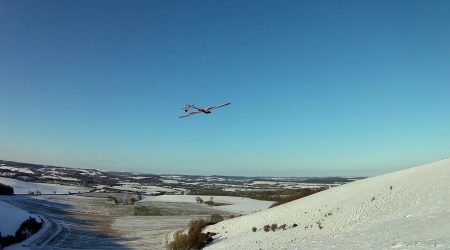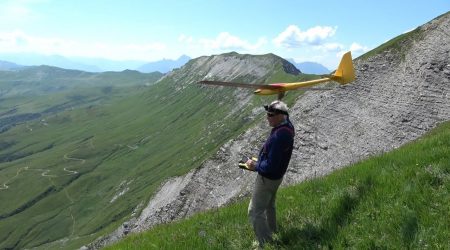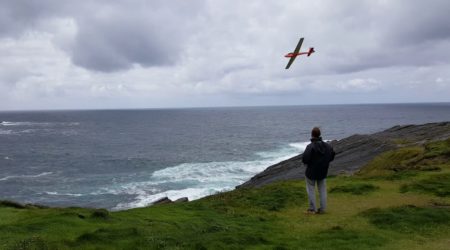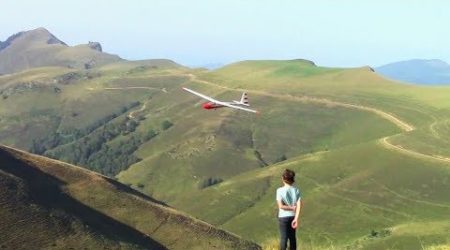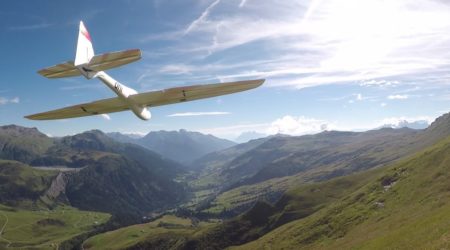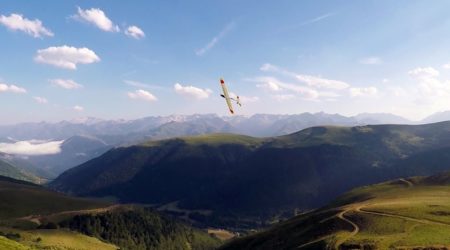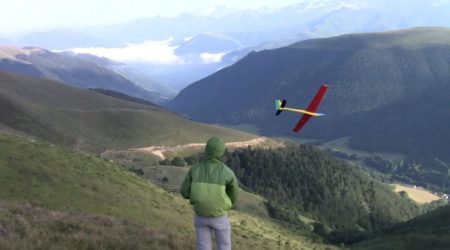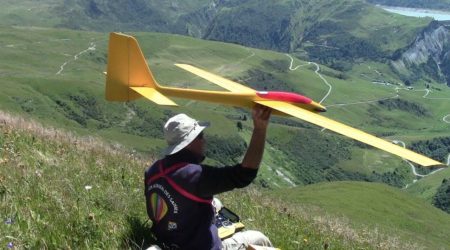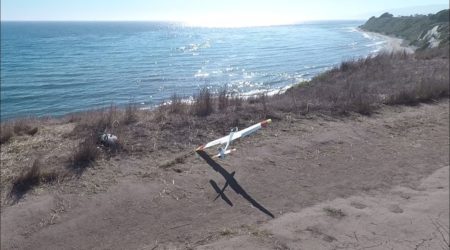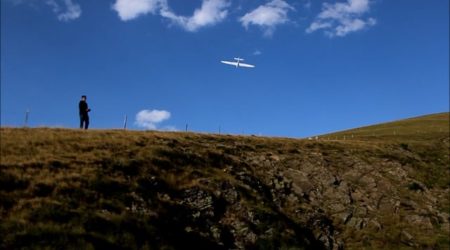
Oh man, this video is fantastic… there is a tremendous slope aerobatics scene going on in Italy and this video is a wonderful example. Look at all those beautiful large molded gliders, and what a flying site! Simply wonderful!!
Got a chance to fly Ellwood in 12-15mph wind, which is quite a bit stronger than usual, and coming in offcenter from the right. I had both my traditionally-built Le Fish as well as my ultralight-built version, so I took some video of each flying to help illustrate the differences in how they fly. The flying itself is nothing special, but I hope it helps show how differently the design flies at each weight.
The traditionally built Le Fish is the original prototype that first flew back in 2006. It weighs 38oz and is covered in Solartex and Ultracote, along with thinned Goop both under and over the covering for extra durability. It has a traditional fixed elevator. Overall, the lift allowed it to fly pretty nicely, but it felt very heavy on the sticks compared to what I’ve become used to from the ultralights. It’s nowhere near as agile, which is to be expected since it’s more than twice as heavy.
The ultralight built Le Fish was first flown in the summer of 2011 and weighs 17oz. It is covered in laminating film and has a Madslide-inspired full flying stabilizer capable of about 150* of travel, allowing for tight flip maneuvers. It too enjoyed the lift conditions, although like with the heavier Le Fish the offcenter wind direction wasn’t optimal. It’s clear that the ultralight plane is much more agile, though with less energy retention, than the heavier plane. Again, to be expected given the weight difference between the two.
Overall, for me and the kind of flying I’m interested in doing today, the ultralight plane is a far better match. The heavy Le Fish was flying OK in these conditions but really would’ve come alive had the wind direction been more straight-in. The light Le Fish, by comparison, was quite happy to fly in a small space and perform trick after trick, able to be manipulated into all sorts of interesting situations thanks to its light weight and extremely low inertia. Honestly it’s a totally different philosophy of aerobatic slope flying, something that comes from flying the Dream-Flight Weasel and Alula more than any other influence. I dig it!
The Akhenaton kit is complete and includes all the wood required to construct it, sheeting, longerons, epoxy control horns, carbon wing joiner, and similar. All that is needed to complete the plane is glue and covering material.
Akhenaton specs:
Span: 1975 mm
Length: 1290 mm
Weight: 1070 grs
Wingloading: 31 g/dm2
Profile: TP29-9
Radio: 4 servos
This is the Acro, a 2m, 33oz EPP scratchbuilt design by Don Link being flown by his son Justin Link at Little Mountain near San Bernardino. It flies really nice and looks cool
Here’s the Valenta Cappuccino flying in some fantastic lift at Rhossili, Wales. Cliff Hanger was the winner of last year’s video contest and is able to deliver, as in this video, some of the smoothest big air flying you’ll see anywhere.
I’ve seen and flown Cappuccino’s and they’re excellent gliders for this kind of big air flying. Roger shows the plane has a significant amount of potential as an aerobat. Very, very cool stuff!
Another cool new video from Dawson. He’s flying his lightweight Le Fish in some pretty strong conditions at Mormon Lake Overlook near Flagstaff, Arizona. After having his vertical stabilizer once again “surgically removed” at WeaselFest by a ravenous Weasel (this is the second time this has happened!), he’s gone ahead and modded his rudder to try a lower aspect ratio shape. It seems to give some interesting performance changes.
Here are his comments: “I had just replaced the tail group of my Le Fish Light with something a little different. The vertical stab and rudder were much more low aspect and had about 60° of throw both ways. The horizontal stab had lightening holes cut behind the spar and additional counter weights added to the LE… balancing the stab fore and aft. I liked the changes. The new rudder seemed to help with stall maneuvers… especially the spins and the H-Stab never fluttered.”
Watch for the really cool outside spin beginning about 1:45… he loses almost no altitude (thanks to his Le Fish’s superlight 21.5oz weight) and ends up doing pirouettes around the nose. Very cool! Beautiful smooth flying from Dawson despite what look to be fairly blustery conditions… always a pleasure to watch him at play!!
P.S. – keep watching till the very end for the surprise bonus segment!
Rhys Porter of Australia has built and flown this very cool 40″ wingspan Le Fish scratchbuild using a downscaled version of the Le Fish plans. Posting about it in the “How to Build a Swiss Fish” thread, he writes:
“Vac bagged fuse and wings, super light layup with only one layer of very very light glass over most of it, with two layers in the LE and around the nose of the fuse. 5mm Carbon Tow strips as spars top and bottom, Kevlar hinges. Aimed to make this as light as possible, so it will come out of the bags looking DLG style… Fingers crossed it works!”
It came out great and has got to be one of the smallest Le Fish I’ve heard of yet. Looks like it’s fun to fly… great job Rhys!
So it turns out there’s a pretty good aerobatics scene in Colombia! Here is a nice video of Carlos Calvache flying his Le Fish outside Bucaramanga, his hometown. This was his second Le Fish; he built his first one in 2006 and it was the first one shipped to Colombia. So cool to see this! Next he says he plans to build a lightweight version. I can’t wait to see what develops from this.